what we think, where we are, where we are going...
Table of Contents
- Synopsis
- Which actors can counteract the climate crisis?
- Which actors can effectively counter the climate crisis?
- How to increase the probability that people can effectively counteract the climate crisis?
- Actions carried out by Association Resconda to promote conscious repayment of environmental debt
- Suasì
Synopsis
- The document analyses the climate crisis, identifying three main actors in the fight against climate change: States and international organisations, NGOs, and people, highlighting the limits and difficulties each faces in effectively addressing the problem.
- It concludes that the solution cannot be delegated to States or NGOs alone, but must directly involve individuals, especially in high-consumption countries, through a cultural, educational and cognitive change that enables people to measure and reduce the environmental impact of their actions.
- The initiative of the Resconda Association is presented, which promotes tools such as the Suasì app to provide quantitative information on the environmental impact of individual consumption, facilitating informed choices and the repayment of environmental debt.
Which actors can counteract the climate crisis?
Currently, the fight against climate change is entrusted to three types of actors:
- States and the international organisations they create. This field of action is, so to speak, “natural”: the phenomenon has such dimensions and complexity that it requires joint collective actions at a supranational level.
- Organisations formed by private individuals dedicated to this purpose, usually NGOs.
- The people in a broad sense, the inhabitants of the world: earthlings.
The problem of climate change should be analysed using risk assessment methodologies regarding the ability of the above actors to introduce measures for prevention and containment of climate change, their potential effectiveness and the relative probability of success. In fact, each of the actors listed above has characteristics that can potentially undermine the effectiveness of their actions.
The limits of States
States (and those who represent them) are forced—in most cases—to obey a logic based on wealth production/resource consumption, to ensure their own development but often also their very survival. The underlying problem is the correlation between economic growth and consumption of natural resources. A certain narrative of the so-called “green economy” has tried to overcome the problem through an alleged decoupling between economic growth and environmental impact, but without success[1], especially regarding energy consumption, which is closely linked to GDP and social development.
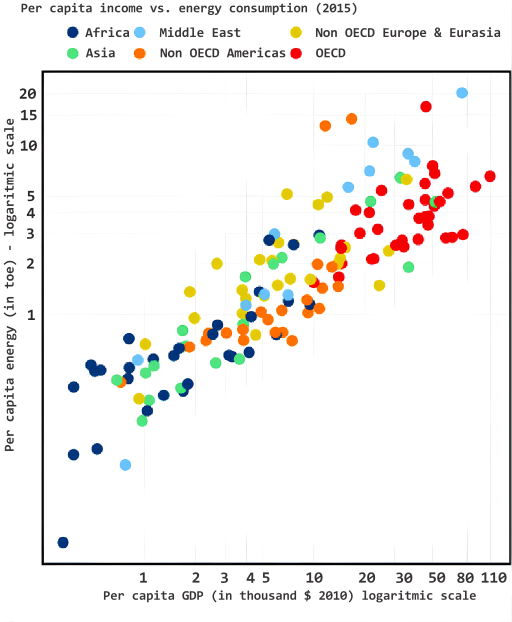
This need is incompatible and antithetical to the objectives of fighting climate change. One of the components that strongly pushes States in this direction is the presence of high public debt, whose servicing cannot be performed without economic growth, under penalty of default (i.e. the death of the State). It is thus not reasonable to expect States (as any other biological or non-biological organism) to act in a way that may favour their own demise.
There are clear signs confirming this difficulty: in 30 years of annual Conferences of Parties (intergovernmental meetings aimed at reducing GHG emissions into the atmosphere), a reduction in emissions was only recorded in 2009 (caused by the global economic crisis following the subprime/Lehman Brothers cases) and in 2020 (caused by the Covid19 pandemic).
The increasingly conflictual course of international politics, the tendency to prioritise traditional economic reasons over those of fighting climate change, and lately the disengagement of some major States (e.g. USA, EU) in this regard and generally towards supranational collaborative systems, further reduce the probability that these actors can exercise effective action in this field.
It should also be mentioned that climate change containment measures have rather long return times (on the order of decades) and are therefore mostly outside the time perspective of state representatives, normally limited to the duration of a mandate of 4 or 5 years (at least in state organisations with an electoral system), and thus cannot constitute an objective of interest for political figures whose priority is the electoral success (their own or their party’s) in the next elections.
Finally, political representatives are particularly subject to pressure from lobbies (economic and productive) whose interests are often antithetical to containing the climate crisis.
The limits of Non-Governmental Organisations
NGO activity is generally extremely fragmented, lacking coordination and systemic vision. NGOs are focused on specific aspects and areas of intervention, which makes their actions scattered, as well as often limited by available resources. Moreover, the quest for resources (human and financial) often generates competition among NGOs, which further limits the possibilities for collaboration between them.
In fact, their action (even those of the largest ones, such as Greenpeace, WWF, etc.) never seems to go beyond the periodic and iterative denunciation of the deterioration of specific environmental aspects, without this resulting in a change in the logic of the socio-political and economic system sufficient to alter the course of events.
Finally, their ability to influence the system is not only jeopardized by the amount of resources they can gather (human, financial) but also dependent on their ability to be represented in mainstream media, all this making their activities subordinate to the expectations of their “major contributors” and/or to the needs of mainstream media.
The limits of people
People are hindered in their action by countless factors, generally attributable to three categories of reasons, relating to cognitive biases, to the specificities of the problem and to the human nature:
- Many people are unaware of the causes of climate change and/or the scenarios that may result from it or, if they are not, do not think they are (often rightly so) among those who must take responsibility for the solution.
- Many people do not consider climate change relevant and find confirmation of their opinion on social media (due to operating algorithms) and also as a consequence of the high propensity for polarisation of topics (confirmation bias).
- Information on the topic is neither accurate nor sufficient, and users often find it difficult to distinguish true information from misinformation.
- The idea (more or less conscious) that governments and companies are better positioned to address the problem than individuals prevails, also in relation to the perceived complexity of the topic.
- There is a total lack of quantitative information: people largely know (at least partially) what is better and what is worse for the environment, but lacking quantitative knowledge and thus without being able to assess the impact of their behaviours, they substantially act without awareness.
- Many people think they do enough for the environment in their daily lives. However, in the absence of quantitative information on the impact of their actions, this assumption risks being unfounded.
- Many people think that their actions, however targeted and effective, cannot have any real effect on the problem, considering the impact of other individuals (especially understandable in countries with relatively low resources consumption levels).
- Many people consider other problems (especially those related to the economy, conflicts, etc.) to be more important and that the environmental problem should be subordinated to them.
- Specific human cognitive and psychological mechanisms - the result of an evolution that has allowed humans to establish themselves over hundreds of thousands of years as the dominant species on the planet - can prove unsuitable and detrimental in addressing the climate crisis. In particular:
- The temporally deferred dimension of the problem, whereby the effects of actions taken today become perceptible in a few decades (especially when actions intended to prevent a harm, that do not result in any evident effect). This aspect reduces interest and willingness to act.
- The spatially deferred dimension of the problem: those who do not feel directly affected by climate change today do not feel the need to act, even if they are aware of effects occurring elsewhere.
- The size and complexity of the problem - which appears to the individual as complex and immeasurable - generates anxiety (eco-anxiety) and seems impossible to tackle.
Which actors can effectively counter the climate crisis?
In relation to the above, we have reached the following conclusions:
- It is vain (if not counterproductive) to thoroughly delegate the solution of the problem to States, the Organisations they have created, and NGOs, for the reasons outlined above.
- People remain - in particular those with the highest per capita consumption and to the extent that they want and are enabled to act - the actor that can act for the containment of the climate crisis. However people must overcome a series of difficulties related to the specificity of human nature, to inadequate cultural and value models and to the cognitive biases of which they are victims.
How to increase the probability that people can effectively counteract the climate crisis?
To overcome the difficulties mentioned above, it would be necessary to intervene simultaneously in a pervasive and massive way on the educational, cognitive and cultural levels, through a multiplicity of actions and levels of intervention.
Given the size and complexity of such intervention, as an Association we have decided to intervene on a specific cognitive aspect: trying to provide people with quantitative information regarding the environmental impact of their consumption and behaviour choices, adopting the energy consumption produced by their choices as a guiding parameter of environmental impact. The objective of this intervention is to create a shared knowledge system.
Such a knowledge system, based on quantitative assessments, is currently completely non-existent. The main parameter for quantitative assessment of environmental impact, carbon dioxide equivalent (CO2e) is known to all but at the same time substantially unknown: how many people are able to understand what a kg of CO2e means and what it corresponds to in their daily habits and consumption behaviours?
A 4-year-old child would have no objections to statements like “it took me an hour to walk from Paris to Rome” or “I spent 1,200 euros for a kilo of apples at the market”, but you who are reading have immediate evidence of their inconsistency and absurdity, because you share a widespread knowledge about the quantitative aspects related to time, space, weight, currency, etc. connected to our life: this knowledge allows us an immediate and directionally correct assessment of the situations we face daily, and our choices are anchored to it.
How many, instead, would consider to be absurd the statement “This t-shirt has an ecological footprint of 100 g of CO2 equivalent”? Very few. Yet, the order of magnitude of the error is the same as the previous statements: 100 x (the footprint of a t-shirt is around 10 kg)!
Lord Kelvin said: “If you cannot measure it, you cannot improve it”.
If we truly want to promote a culture of sustainability of individual action at a collective level — substantial and not wishful — it is necessary that people are enabled to measure daily the level of environmental compatibility of their behaviour, purchasing and lifestyle choices.
We are aware of how ambitious this goal is and how limited our chances of achieving it are, but we are guided by the optimism of will and trust in the profound meaning of the proposed action. We believe this is the right path to quickly and effectively counter the climate crisis and that it can be undertaken with a relatively modest effort.
The creation of a shared cognitive infrastructure on the quantitative aspects of the environmental impact of individual actions and behaviours is in fact a prerequisite for acting collectively towards a real and effective contrast to the environmental crisis.
We intend to promote the creation and dissemination of:
- Reliable information because it is based on validated and consolidated (albeit indicative) systems of environmental impact analysis (Embodied energy, Cumulated Energy Density, LCA analysis)
- Shared quantitative information, definition of clear and unambiguous individual impact objectives, and cognitive tools useful to achieve them by modulating daily behaviour and purchasing choices to ultimately reduce one’s energy footprint.
- Individual awareness of the measure of one’s environmental impact, its possible reduction, and possible ways to achieve it;
- Reduction of the perceived complexity of the topic, reduction of eco-anxiety.
Actions carried out by Association Resconda to promote conscious repayment of environmental debt
“Conscious repayment of environmental debt” is, in fact, the concept at the basis of the Association (and its name) and reflects the desire to ensure that every earthling can act consciously within the framework of a shared action to restore environmental balance. To achieve this goal, the Association has, in recent years:
- Carried out an information campaign (through newsletters, website, and social media) aimed at informing about the quantitative aspects related to the energy impact of individual behaviours (purchasing and otherwise);
- Held information meetings and seminars at schools and universities.
- Conceived, promoted and created the “Suasì” App, a tool (as better explained hereafter) through which individuals and families can presently assess, in purchasing goods, how and to what extent they contribute to reducing their environmental impact, based on reliable data and setting precise and measurable objectives.
Suasì
Every product/service has an environmental cost, as it uses natural resources for its production and delivery; among these, one is always present: energy.
Energy quantification can be used as a guiding parameter for conscious consumption, inducing the consumer to choose products with lower energy content (especially the fossil fuel based one) so as not to exceed its “energy budget”, just as the sale price of a good is the main parameter for a consumer who does not want (or cannot) exceed its economic budget.
The EMCoin project (EMbodied energy as a Coin) consists in creating a system for accounting the Emergy (Embodied energy) of products aimed at making the consumer aware of the environmental impact of its purchasing choices and able to decide how and to what extent to pursue its sustainability objectives.
The project, launched in 2022, was made possible by contributions from the Waldensian Church, research funds from DISEG Polytechnic of Turin (Prof. C. Mele) and from the European Union, with the collaboration of various public and private entities.
Thanks to the work of researchers and other involved parties, a methodological framework of average individual energy consumption applied to food, beverages, and detergents has been created, whose emergy values have been collected through specially developed databases (Ecoinvent, Agribalyse) and product EPDs. The system has been incorporated into an App: Suasì, currently the only one (as far as we know) aiming to provide a comprehensive and reliable guide towards environmentally sustainable choices by consumers and to nudge manufacturers to lower the fossil fuel energy embodied in their products.
Each of us, through daily purchasing choices, can contribute to the fight against climate change, provided we know how these actions can affect the reduction of environmental impact.
Suasì is the first App that allows you to know this data and aims to provide a tool through which individuals and families can assess, at the time of purchasing goods, how and to what extent they contribute to reducing their environmental impact, based on reliable data and by setting precise and measurable objectives.
SuaSì comes from the ancient Gothic “kausjan”, which meant “to examine, test, understand”.
Suasì is available on IOS and Android platforms.
Further information is available at www.suasi.it
[1] c20Deceitful Decoupling: Misconceptions of a Persistent Myth, in The Barcelona School of Ecological Economics and Political Ecology, Springer, 2023 https://link.springer.com/book/10.1007/978-3-031-22566-6